
Ducts Functions in HVAC Systems – Complete Guide


Understanding ducts functions is the foundation of every well-performing HVAC system. The ducts functions performed by a precision-fabricated air distribution network determine whether a mechanical system delivers its design airflow, maintains indoor air quality, controls energy consumption, and meets regulatory compliance – or fails on all four.
For MEP contractors, mechanical design engineers, and procurement managers working on commercial and industrial projects across Saudi Arabia and the GCC, the air duct purpose is not incidental to system performance. It is system performance.
This guide covers the complete ducts functions in HVAC systems: air distribution principles, duct types, design parameters, and fabrication standards aligned with SMACNA, ASHRAE, and NFPA requirements.
What Are HVAC Ducts?
HVAC ducts are enclosed passageways – rectangular, circular, or flat-oval in cross-section – fabricated to transport conditioned air from air handling units (AHUs), fan coil units (FCUs), or rooftop units (RTUs) to occupied spaces and back through a controlled, pressure-driven network.
Definition: An HVAC duct is a fabricated air passage, constructed from galvanized steel, pre-insulated panels, or black steel, designed to convey conditioned air at defined pressure classes and flow velocities in compliance with SMACNA duct construction standards.
Duct system components – supply duct sections, return duct panels, elbows, tee branches, volume dampers, fire dampers, and terminal air outlets – each contribute a specific role within the overall air distribution system. The air duct purpose at the system level is coordination: every component performs its individual ducts functions while the network as a whole delivers the airflow, pressure, and thermal performance the HVAC design requires.
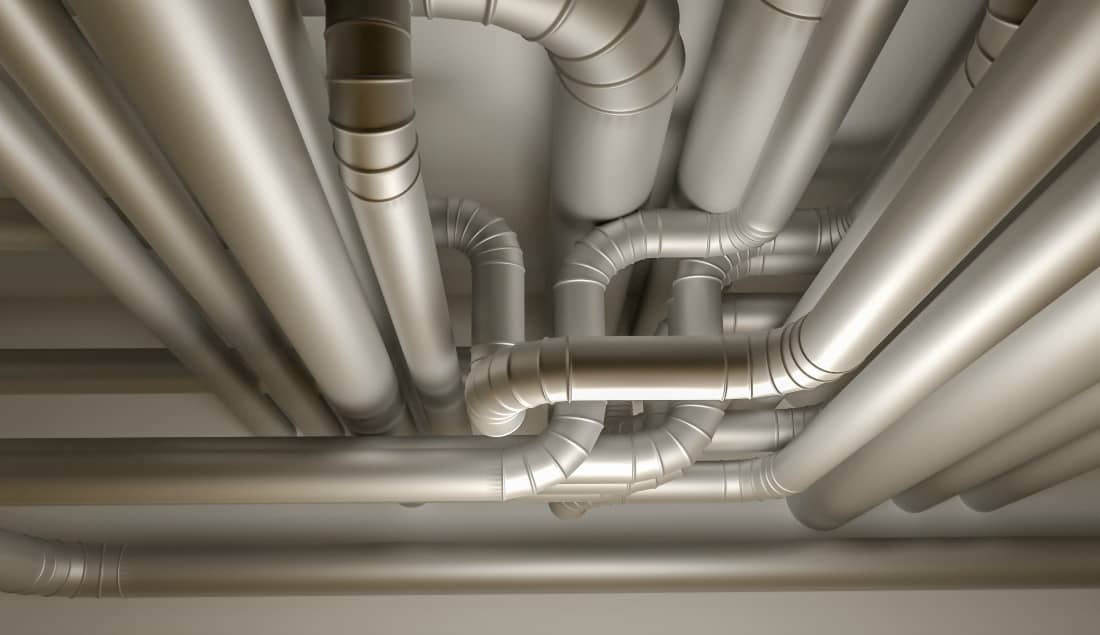
El Samman Factory for Air Distribution Systems manufactures and supplies fabricated duct systems for large-scale HVAC projects across Saudi Arabia, operating production facilities in Jeddah and Riyadh.
Main Ducts Functions in Air Distribution Systems
The role of ductwork in HVAC performance covers six interdependent duct functions. Each HVAC duct function – from air distribution to leakage control – must be designed, fabricated, and installed to defined tolerances. Consequently, treating any of these ducts as secondary to equipment selection is a primary cause of HVAC underperformance on large-scale commercial projects.
Air Distribution Process
The primary duct function begins with controlled air distribution: delivering the correct volume of conditioned air, at the correct velocity and temperature, to each zone of a building.
Without accurate air distribution, ventilation rates, occupant thermal comfort, and indoor air quality standards cannot be achieved regardless of equipment capacity.
The duct system maintains target static pressure at every branch takeoff and terminal device with minimum pressure drop across the network.
Each supply branch must be sized to deliver its design airflow – in CFM or L/s – based on the zone’s calculated cooling or heating load.
In main supply ducts, velocity typically ranges from 5 m/s to 10 m/s in commercial applications, reducing to 2.5-4 m/s at terminal branches to control friction loss and noise.
Duct sizing is therefore the engineering expression of the air distribution function translated directly into fabrication specifications.
Air Supply vs Return Ducts
The supply-and-return duct function is the structural backbone of any HVAC air distribution system. Understanding how each network performs its HVAC duct function under operating pressure is essential for correct pressure class selection.
- The supply duct network carries conditioned air from AHU or FCU equipment to supply air outlets at positive static pressure relative to the conditioned space.
- The return duct network returns air from the conditioned space to the AHU at negative static pressure. Return ducts must therefore be fabricated to resist panel deflection under vacuum within SMACNA deflection limits – a fabrication requirement that is frequently overlooked in low-pressure class specifications.
In critical facilities – hospitals, clean rooms, data centres, and government buildings – fully ducted return systems are required. In standard commercial buildings, ceiling plenum return is common but increases the risk of unfiltered air ingress if air tightness at duct joints is not controlled.
Ventilation Role
The ventilation duct function delivers fresh outdoor air to occupied zones in compliance with ASHRAE 62.1 minimum ventilation rate procedures – a requirement mandated in commercial occupancies across Saudi Arabia under the Saudi Building Code.
Minimum outdoor air rates are determined by occupancy category, typically 2.5-10 L/s per person for office and retail applications.
In Saudi Arabia, where sandstorms and coastal humidity affect outdoor air quality significantly, the ventilation duct network must handle pre-filtered outdoor air under elevated operating pressure without joint or seam leakage.
Failing this ducts function introduces unfiltered particulates directly into the conditioned air supply.
Impact on Indoor Air Quality
The IAQ duct function is the least visible but arguably the most critical of all ducts functions for building occupants – particularly in GCC climates where outdoor particulate levels and humidity create condensation and contamination risk if duct system components are not properly sealed and insulated.
Air leakage from supply ducts into ceiling plenums draws unfiltered air through building envelope gaps, introducing particulates, VOCs, and biological contaminants into occupied areas. Controlling IAQ through duct fabrication requires:
- Leakage class CL6 or better for low-pressure systems, achieved through duct sealing at all longitudinal seams and transverse joints using approved mastic sealants
- Internally clean duct surfaces – free of rust, oil, and particulate contamination – at time of installation
- Positive pressurisation maintained in critical spaces through air-balanced duct networks, verified by air balancing commissioning
- Vapour-barrier insulation on cold supply duct surfaces – a specific ducts functions requirement in Saudi Arabia’s high-humidity coastal environments (Jeddah, Yanbu, Jizan) where surface temperatures below dewpoint cause moisture accumulation inside uninsulated duct sections
El Samman applies mastic sealant and foil-tape joint sealing as standard on all fabricated ducts, with QC inspection at each stage before delivery.
Additionally, all pre-insulated duct panels are fabricated with double-sided aluminium foil facing to provide a continuous vapour barrier across the full duct surface.
Types of Duct Systems
Each duct type is selected to perform specific ducts functions under defined operating conditions. The choice of duct system components and configuration is driven by pressure class, thermal performance requirement, fire rating, and spatial constraints on the project.
- Galvanized Steel Rectangular Duct is the standard type for commercial HVAC applications across the GCC. Fabricated from hot-dip galvanized steel complying with ASTM A653, with zinc coating class G60 or G90 for corrosion resistance in humid coastal environments. Sheet gauge is selected per SMACNA Table 1-19 based on duct width and pressure class.
View El Samman’s HVAC duct range
- Pre-Insulated Duct (PIR / Phenolic Panels) combines structural rigidity with integrated thermal insulation in a single composite panel, eliminating external duct wrap. The thermal ducts functions of pre-insulated panels exceed those of separately insulated galvanized duct in tight plenum spaces and fast-track projects. PIR panels achieve a thermal conductivity of 0.022-0.026 W/m·K; phenolic panels achieve 0.018-0.022 W/m·K – both exceeding ASHRAE 90.1 insulation requirements for GCC Climate Zone 1B.
View pre-insulated duct systems
- Spiral Round Duct is fabricated by helical winding of galvanized steel strip, with diameters from 80 mm to 1,600 mm. The continuous helical seam provides inherently lower air leakage than rectangular duct and supports tighter leakage class compliance, making it the preferred type where leakage class is a project specification requirement.
- Flexible Duct serves the final connection between rigid duct branches and terminal devices. Its ducts are limited to the last 1.5 m of a branch run per SMACNA guidelines. Longer unsupported lengths collapse under negative pressure, increasing friction loss and defeating the air distribution function of the system. In GCC climates, flexible duct must include a vapour barrier outer jacket to prevent condensation damage.
- Black Steel Duct is specified for kitchen exhaust systems (NFPA 96 – minimum 1.6 mm wall thickness), smoke exhaust, and pressurisation systems (BS EN 12101-6). The smoke control function requires continuous external welded seams to maintain structural integrity at elevated temperatures under fire conditions.
- Fire-Rated Duct Assemblies perform the fire compartmentation function, protecting fire boundaries from smoke and flame spread for 60, 90, or 120 minutes as specified by the project fire engineer – coordinated with fire damper positioning per NFPA 90A and the Saudi Building Code SBC 801.
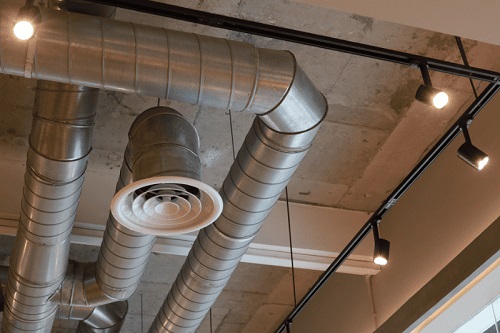
Browse the full El Samman duct product range – HVAC duct, pre-insulated panels, and air outlets.
How Duct Design Affects Performance
Duct system design directly determines HVAC energy consumption, equipment life, and occupant thermal comfort.
Duct leakage, inadequate insulation, and oversized pressure drop are the three most common duct system failures that drive non-compliance under ASHRAE 90.1.
Each design parameter represents a quantifiable ducts function variable that must be validated before fabrication drawings are issued.
Furthermore, the role of ductwork in HVAC energy compliance under ASHRAE 90.1 is direct: duct system components that do not meet leakage class and insulation requirements are a code non-compliance, not an installation shortcut.
- Pressure Drop and Static Pressure. Every fitting – elbow, tee, transition, offset – contributes local resistance in addition to straight duct friction loss. Total equivalent length (TEL) analysis must be applied during duct sizing to accurately predict fan duty. Underestimating duct pressure drop leads to undersized fan selection and insufficient airflow delivery – a direct failure of the air distribution ducts functions in GCC projects where cooling loads are extreme.
- Duct Leakage and Energy Loss. Air leakage from the duct system is a primary source of HVAC energy waste. SMACNA Leakage Class CL6 sets a maximum permissible air leakage rate for low-pressure systems – a threshold El Samman meets as standard through sealant application at all transverse joints and longitudinal seams. Uncontrolled air leakage is a direct failure of the containment function and compromises every downstream HVAC duct function simultaneously.
- Thermal Performance and Insulation. In Saudi Arabia’s climate (ASHRAE Climate Zone 1B), supply air ducts operating at 12-14°C in a 45°C unconditioned ceiling plenum will experience significant heat gain without adequate insulation. El Samman’s pre-insulated duct panels with 25 mm PIR core deliver an effective R-value of approximately R-6.0 – exceeding ASHRAE 90.1 minimum requirements for GCC climate zones and ensuring that the thermal ducts functions of the system are maintained across the full duct run.
- Acoustic Performance. Duct-borne noise is controlled through duct velocity limits. For noise-sensitive spaces – executive offices, hotel bedrooms, healthcare facilities – ASHRAE recommends maximum supply velocities of 3.5-4.5 m/s. Exceeding these limits generates turbulence-induced noise at fittings and terminal devices that no downstream treatment can fully correct.
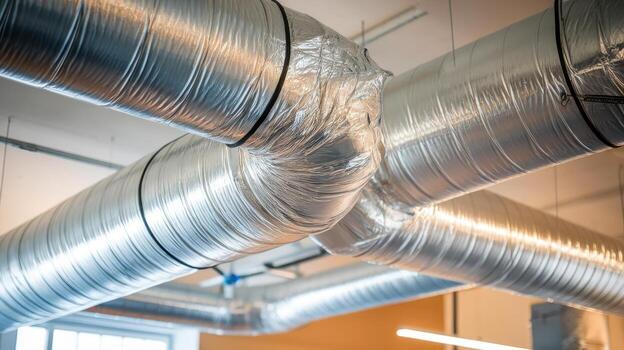
Duct Efficiency & Energy Savings
The role of ductwork in HVAC energy performance is direct and measurable. Each ducts functions category – air distribution, leakage control, thermal insulation, air balancing, and pressure optimisation – has a quantifiable energy impact. In HVAC zoning systems, where multiple air handling zones share a duct network, ducts functions failures compound: a leaking high-pressure main duct degrades the HVAC duct function across all connected zones simultaneously.
A properly designed, fabricated, and installed duct system reduces HVAC energy consumption by 15-30% compared to a system with poor duct sealing, inadequate insulation, and substandard fabrication. The key efficiency factors are:
- Air distribution: Correct duct sizing at every branch ensures each zone receives its design airflow without forcing excessive damper throttling
- Leakage control: Achieving CL6 or better through sealant application at all joints reduces the additional airflow the AHU must generate to compensate for air leakage losses
- Thermal insulation: Adequate insulation R-value limits supply air temperature rise in unconditioned plenums, reducing the cooling load the refrigeration plant must overcome
- Air balancing: Accurately commissioned volume dampers eliminate excessive throttling that increases system pressure drop and creates noise
- Airtight construction: Structural integrity under operating pressure prevents panel deflection that increases friction loss – a passive ducts functions requirement demanding precision fabrication
The air duct purpose is only fully realised at the terminal device – the diffuser, grille, or linear slot outlet through which conditioned air enters the occupied space.
Terminal duct velocity directly determines outlet throw, spread, and room air distribution pattern. For this reason, air outlet selection must be coordinated with duct branch sizing from a single specification scope.
El Samman supplies a full range of air outlets alongside its duct fabrication scope, ensuring terminal device performance is matched to duct delivery parameters.
Working on a commercial or industrial HVAC project in Saudi Arabia? El Samman’s engineering team provides technical support from duct specification through to site delivery.
FAQ about Ducts Functions in HVAC Systems
What is the role of ducts in an HVAC system?
Ducts distribute conditioned air from HVAC equipment to different areas of a building and return air to the system. Proper duct design helps maintain efficient airflow, comfort, and indoor air quality.
What are the two types of ducts?
The two main types are supply ducts and return ducts. Supply ducts deliver conditioned air into rooms, while return ducts carry indoor air back to the HVAC system for treatment.
How does an HVAC duct system work?
An HVAC duct system transports heated or cooled air between the HVAC unit and the spaces being conditioned. The ductwork is designed and arranged to support balanced airflow throughout the building.
What are the different types of air ducts used in HVAC systems?
Common types include rectangular, round, and oval ducts, which can be manufactured from materials such as galvanized steel, aluminum, or other suitable materials. The appropriate duct type depends on the building design, airflow requirements, and project specifications.
Read also: