
HVAC Sound Attenuator: Types, Selection, AHU Placement and Price

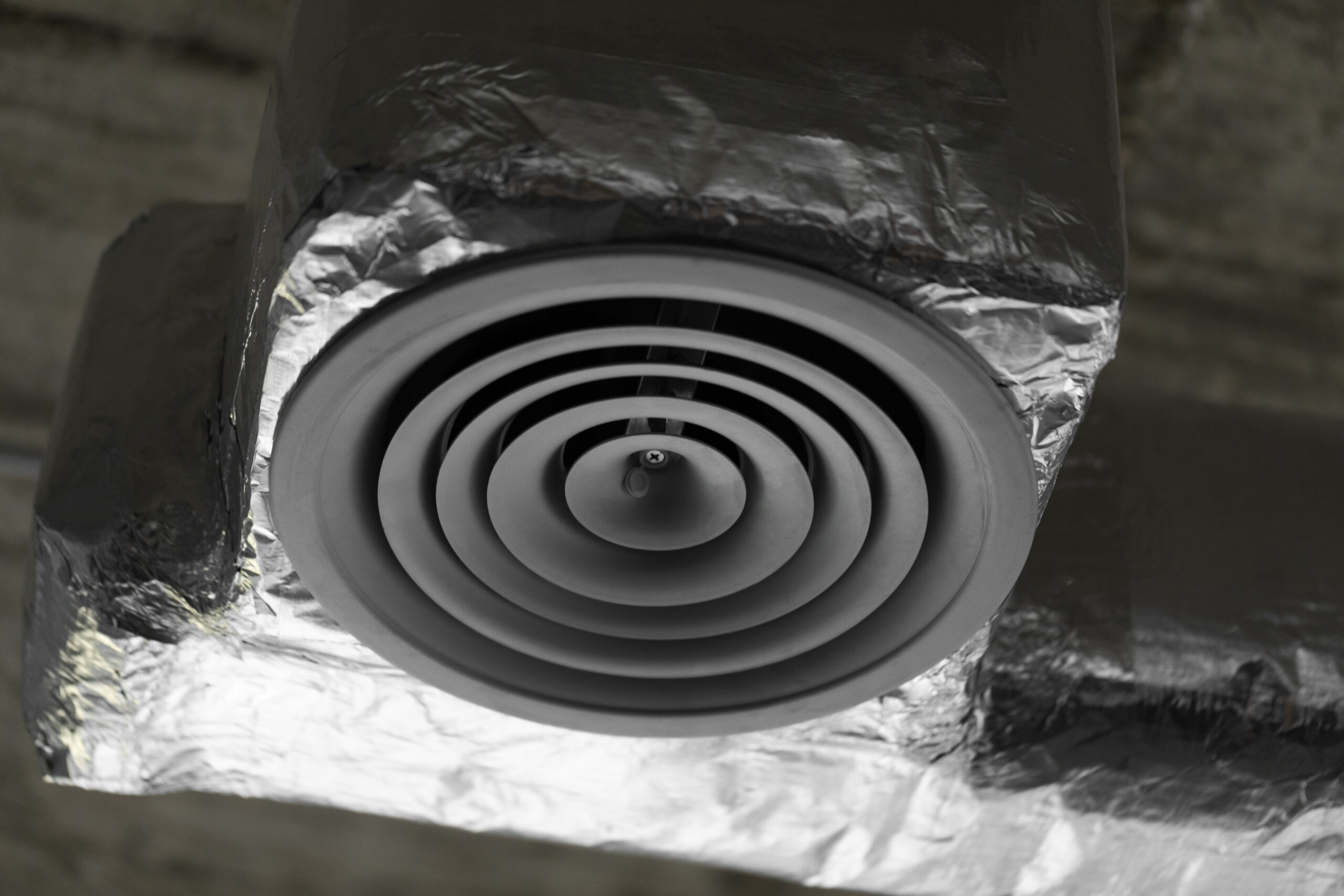
The ducts are sized, the fans are running, and the meeting room next to the plant room is still too loud. Fan noise travels through ductwork very well. An HVAC sound attenuator stops it inside the duct before it reaches the occupied space. This guide covers types, selection, AHU placement, the silencer naming confusion, and price.
How an HVAC Sound Attenuator Works
An HVAC sound attenuator is a short duct section filled with sound-absorbing material. Air passes through, and the noise is trapped.
Inside every attenuator are parallel splitters made of mineral wool or fiberglass, covered with perforated metal. Sound energy hits the media and turns into tiny amounts of heat.
The airflow through the HVAC attenuator stays almost unobstructed. The noise does not, because it cannot travel straight through the splitters.
Types of HVAC Sound Attenuators
Most HVAC attenuator units are dissipative, meaning they absorb sound. They work best in the mid and high frequencies, where speech and hiss live.
Reactive types use chambers and tuned cavities instead of absorbing media. They suit narrow low-frequency problems, and they are less common in commercial buildings.
Shape matters too. Pick the HVAC sound attenuator that fits your routing:
- Rectangular straight: the standard choice for main supply and return ducts
- Circular: lower cost and easier fitting on round ducts and branches
- Elbow: combines a bend and a silencer where space is tight
- Crosstalk (Z or L shape): blocks speech passing between adjoining rooms through a shared duct
Low frequencies are the hard part for any HVAC attenuator. Fan noise is heavy around 63 to 250 Hz, so check the low-band figures in the data, not just the headline number.
Sound Attenuator for AHU: Where to Place It
A Sound Attenuator for AHU applications is needed on both sides of the unit. Fan noise travels down the supply duct and back through the return and fresh air ducts.
Put the HVAC sound attenuator close to the plant room wall, ideally at the point where the duct leaves the room. If it sits far down the duct, noise breaks out through the duct wall before the silencer can catch it.
Leave the straight duct lengths the manufacturer specifies before and after the HVAC. Turbulence from a nearby elbow or fan outlet raises pressure drop and lowers performance.
Use a flexible connector between the AHU and the duct, and support the HVAC sound attenuator from the structure. The duct should never carry its weight.
Where hygiene matters, such as hospitals and kitchens, ask for a film-faced or lined HVAC so fibres cannot shed into the airstream.
Planning an AHU room? Samman can coordinate duct connection sizes with your HVAC data before fabrication.
HVAC Sound Attenuator Installation Best Practices
Correct installation is essential for achieving the specified acoustic performance of an HVAC sound attenuator. Even a properly selected unit may underperform if the connections leak, the casing is damaged, or nearby fittings create excessive turbulence.
Follow these installation practices:
- Verify the attenuator dimensions, airflow direction, and approved installation orientation before fitting.
- Provide the manufacturer’s required straight duct lengths and clearances around the unit.
- Seal duct connections properly to prevent air leakage and unwanted noise transmission.
- Support the attenuator independently where required by its weight and the project design.
- Coordinate flexible connectors and vibration isolation where fan vibration could travel through the ductwork.
- Preserve access for inspection and avoid damaging internal acoustic media during handling.
After installation, inspect the connections and supports, then verify airflow and system noise under operating conditions. Investigate any unexpected noise or excessive pressure drop before final commissioning and handover.
HVAC Sound Attenuator for Hospitals and Clean Environments
Hospitals, laboratories, commercial kitchens, and other controlled environments may require additional attention when specifying an HVAC sound attenuator. In these applications, acoustic performance must be considered alongside cleanability, moisture resistance, fibre containment, and the risk of contamination within the air distribution system.
The specified casing, internal acoustic media, and protective facing should suit the operating environment and the project’s hygiene requirements. Designers should also confirm access for inspection and maintenance, particularly where the attenuator is installed above ceilings or in restricted plant spaces.
Before procurement, review the manufacturer’s documentation for the proposed materials, operating conditions, and maintenance procedures. Where the project requires low-emission or non-shedding construction, obtain confirmation that the selected product meets the relevant specification.
Sound Attenuator Selection: The Numbers That Matter
Sound attenuator selection starts with one calculation. Take the AHU fan sound power in each octave band, subtract the natural loss from duct length and bends, then compare it to the target room noise level. The gap is your required insertion loss.
Then check five values on the HVAC sound attenuator data sheet:
- Insertion loss (dB): by octave band, tested to ISO 7235. Match it band by band, not on average.
- Pressure drop (Pa): at your design airflow. More loss usually means more resistance.
- Generated noise: air rushing through the passages creates its own noise, which rises with velocity.
- Airflow direction: forward and reverse flow give different results, so say which applies.
- Dimensions: length, width and height limits in the ceiling void or plant room.
The trade-off is real. A longer, denser unit cuts more noise but costs fan energy every hour of operation, which matters under ASHRAE 90.1 fan power limits.
The cheapest answer is rarely the shortest unit. Choose the smallest HVAC sound attenuator that meets every octave band within your pressure budget.
Selection Factors
| Selection Factor | What to Check | Why It Matters |
| Insertion Loss | Attenuation values across octave bands | Confirms the required noise reduction |
| Airflow Rate | Design airflow and face velocity. | Helps maintain the required ventilation performance |
| Pressure Drop | Pressure loss at the design airflow | Prevents excessive resistance in the duct system |
| Regenerated Noise | Noise generated by airflow through the unit | Avoids introducing additional noise |
| Dimensions | Duct size, attenuator length, and available clearance | Ensures the unit fits the installation space |
| Acoustic Media | Absorptive material and protective facing | Supports performance and suitability for the environment |
| Installation Location | Distance from fans, bends, and occupied spaces | Helps achieve the intended acoustic performance |
| Manufacturer Data | Tested acoustic and aerodynamic performance | Supports accurate technical selection and approval |
HVAC Sound Attenuator Sizing and Calculation
Sizing an HVAC sound attenuator starts with the required noise reduction, available duct dimensions, and design airflow. The acoustic consultant or HVAC engineer should determine the sound power entering the duct in each octave band and establish the allowable noise level in the occupied space.
The required insertion loss is assessed band by band, accounting for duct attenuation, fittings, breakout noise, and other relevant sound paths. The selected attenuator must provide sufficient attenuation without exceeding the allowable pressure drop or generating excessive airflow noise.
Next, verify the duct cross-section, attenuator length, face velocity, and manufacturer’s performance data at the design operating conditions. A longer unit may improve attenuation in some frequency bands, but it also requires more installation space and may affect system resistance.
The final selection should be checked against the acoustic requirements, fan performance, and available ceiling or plant room space before the equipment schedule is approved.
HVAC Sound Attenuator Insertion Loss by Octave Band
Insertion loss measures how much sound an HVAC attenuator reduces at specific frequencies, expressed in decibels (dB). Manufacturers commonly provide octave-band data because a unit may perform well at high frequencies but offer less attenuation at low frequencies.
When reviewing a selection, pay attention to the 63 Hz, 125 Hz, and 250 Hz bands if low-frequency fan noise is a concern. Higher-frequency bands also matter when the main issue involves airflow hiss or speech-related noise.
Compare the rated insertion loss with the fan sound power data and the project’s target room noise levels. The final assessment should also account for regenerated noise and pressure drop, since an attenuator that reduces transmitted noise can still generate sound when air moves through it at high velocity.
HVAC Sound Attenuator Pressure Drop and Regenerated Noise
Pressure drop and regenerated noise are two important factors in HVAC sound attenuator selection. Pressure drop represents the resistance the unit adds to airflow, while regenerated noise is produced as air passes through the internal passages.
Both depend on the attenuator’s geometry, free area, length, airflow velocity, and internal construction. A design with narrow passages may achieve useful acoustic attenuation but create greater resistance or airflow-generated noise if it is not selected correctly.
Review the manufacturer’s pressure-drop and regenerated-noise data at the actual design airflow. Consider the available fan static pressure and the acoustic limits for the served space before approving the selection. Comparing units under identical operating conditions provides a more reliable basis for technical and commercial evaluation.
Duct Silencer vs Sound Attenuator
For ductwork, there is no difference. Duct silencer, HVAC sound attenuator and sound trap are three names for the same device, and spec writers use them interchangeably.
The real differences sit elsewhere. Internal duct lining is a thin absorptive layer along the duct walls, and it cannot match a splitter-based HVAC attenuator in a short length.
A blower or exhaust silencer is also a different product. It is built for industrial fans and high temperatures, not for building ventilation.
So when a drawing says “duct silencer vs sound attenuator,” read the data sheet, not the name.
HVAC Sound Attenuator vs Acoustic Duct Lining
An HVAC sound attenuator and acoustic duct lining both help reduce noise in ventilation systems, but they work differently. A sound attenuator typically uses internal splitters or acoustic media to achieve measurable noise reduction within a relatively short duct section. Acoustic duct lining uses an absorptive layer along the inner duct walls to reduce sound as it travels through the system.
The right option depends on the required noise reduction, available installation space, airflow velocity, hygiene requirements, and acceptable pressure drop. Duct lining may help control sound over a longer section, while a dedicated attenuator can provide specified insertion loss across selected octave bands.
For an accurate comparison, review the acoustic performance data for the proposed configuration and confirm that the materials are suitable for the intended HVAC application.
Sound Attenuator Price in Saudi Arabia
Sound attenuator price depends on size, length, insertion loss, casing material, and media facing. A rectangular HVAC sound attenuator for an AHU costs far more than a small circular one.
As a market reference range only, small circular units start from roughly SAR 200 to 600. Commercial rectangular units for AHUs often fall between SAR 700 and SAR 4,000 or more per unit, depending on size and acoustic performance.
These are reference ranges, not a fixed quote. A custom elbow HVAC attenuator or a low-frequency design sits above them.
Compare quotes on the same insertion loss table and the same pressure drop. A cheaper HVAC that fails the 125 Hz band costs more to fix on site.
Al Samman Group has served Saudi commercial and industrial projects since 1973, including VOX Cinemas, Faisaliyah Hotel and airports in Abha, Tabuk and Jizan.
These are places where noise control matters, and our ISO 9001:2015 systems cover the ductwork around your HVAC attenuator.
Send us your duct layout and AHU data, and we will help you coordinate the ductwork scope.
HVAC Sound Attenuator Maintenance and Inspection
HVAC sound attenuator generally has no moving parts, but periodic inspection helps identify conditions that may affect acoustic performance or airflow. Dust accumulation, moisture, damaged internal facings, and loose connections can create maintenance concerns, depending on the installation and operating environment.
During inspection, check accessible casing joints, duct connections, internal surfaces where access is permitted, and any visible signs of corrosion or moisture. Confirm that the attenuator remains securely supported and that no modifications have restricted its free area.
Inspection intervals should follow the manufacturer’s guidance and the building’s maintenance plan. If noise levels increase after installation, investigate fan operation, airflow velocity, vibration transmission, duct leakage, and the attenuator’s condition before deciding whether replacement is necessary.
Contact Al Samman Duct for HVAC Sound Attenuator Solutions
Al Samman Group has supported commercial and industrial projects across Saudi Arabia since 1973, providing ductwork solutions for a range of HVAC applications. Our team can help coordinate duct dimensions, AHU connections, and fabrication requirements to match your project specifications.
Contact Al Samman Duct to discuss your HVAC ductwork requirements.
Frequently Asked Questions
What is an HVAC sound attenuator?
An HVAC attenuator is an acoustic device installed in ductwork to reduce fan and equipment noise. It is also called a duct silencer.
What is a sound attenuator duct?
It is the duct section that holds the absorbing splitters of an HVAC attenuator. It connects to the main duct with matching flanges and the same cross-section, or with transitions.
How to soundproof a HVAC duct?
Work on all three paths. At the source, use flexible connectors and vibration isolators on the AHU. Along the duct, fit an HVAC attenuator, keep velocities low and avoid sharp elbows near grilles.
At the duct wall, wrap or lag breakout-prone sections and seal wall penetrations with acoustic sealant. Add crosstalk silencers between rooms that share a duct.
What does an attenuator do in ductwork?
It removes part of the sound energy as air passes through, measured as insertion loss in dB. It does this while keeping pressure drop low enough for the fan to cope.